
While the disruptive potential of generative AI in legal services dominates headlines, the real story lies with the individuals making that transformation possible. For in-house legal teams and law firms facing rapid shifts in regulation and technology, upskilling has evolved from a competitive advantage into the foundation of any successful AI strategy.

Technology Isn’t the Barrier, Preparation Is

With the rapid integration of generative AI into the legal field, one pattern has become clear: the real determinant of progress isn’t the technology itself, but whether teams are genuinely equipped and empowered to use it.

Some of the most inventive and impactful GenAI applications have emerged not just from data scientists or IT specialists, but from legal analysts, project managers, client-facing teams, and graphic designers. Increasingly, lawyers in law firms are also pioneering new uses for GenAI, developing advanced research workflows, streamlining case management, and automating aspects of due diligence.This demonstrates that innovation can originate from any corner of the organization.

These experiences have reinforced an important lesson: generative AI is not a substitute for expertise, it’s an amplifier. However, that amplification is only possible when you give equal priority to developing the people at your organization as you do to advancing your technology.

Why Legal Ops Must Lead the Charge

Many in the legal field understand that GenAI has the potential to boost productivity, streamline routine work, and speed up decision-making. Yet, it’s common to see upskilling pushed off to IT or postponed until after new tools are in place, which can be a misstep that can undermine long-term success.

Legal operations teams and law firm lawyers are particularly well-suited to lead GenAI adoption thanks to their cross-functional insight and ownership of key processes. Law firm lawyers from associates to partners are uniquely positioned to integrate AI into daily practice, given their deep understanding of client needs, matter management, and legal research. Their direct involvement in client services makes upskilling pivotal for both innovation and competitive differentiation. For upskilling to truly make an impact, it must be embedded in the team’s daily workflows, communication, and problem-solving, not treated as an afterthought.

Who Should Be Upskilled First?

It’s easy to assume that GenAI training should target the most technically oriented roles, but true value emerges from those who are deeply familiar with core business challenges, not just the technology itself.

Within legal departments and practice groups, consider prioritizing:

  • Legal operations professionals: They serve as vital connectors among legal, compliance, and business teams.
  • In-house counsel: Particularly those engaged in contracts, litigation strategies, or regulatory matters.
  • Law firm attorneys: Lawyers at all levels, including associates, counsel, and partners, can drive meaningful improvements in client service, litigation preparation, document review, and negotiations by harnessing GenAI capabilities.
  • Business stakeholders: Individuals who work closely with legal and can readily identify areas where automation could make a difference.

Ultimately, focus on team members who grasp the intricacies of your processes and pain points, and who have the curiosity to explore new solutions.

What Legal Professionals Need to Learn

Upskilling for GenAI doesn’t mean transforming lawyers into coders; it’s about equipping them with new ways to communicate and analyze information. Legal teams should concentrate on four foundational areas:

  • Prompt engineering: Learning to design precise, targeted prompts is a practical skill that significantly improves the relevance and accuracy of GenAI-generated results.
  • Responsible AI usage: Teams must know how to use GenAI within ethical, legal, and compliance frameworks, addressing issues like confidentiality, bias, and transparency.
  • Domain-contextual analysis: Exercising legal and business judgment when interpreting GenAI outputs is what distinguishes valuable insights from potential missteps.
  • Leveraging AI: For law firm lawyers, gaining confidence in leveraging GenAI for research, drafting, and advisory roles is especially critical. This includes understanding both the capabilities and current limitations of AI-powered legal tools specific to their practice areas.

Building proficiency in these areas enables legal professionals to adapt quickly and remain effective as technology continues to evolve.

Best Practices for Sustainable Upskilling

Change fatigue is a genuine challenge. To overcome it, training should prioritize ongoing, structured support rather than isolated, one-off sessions.

Consider these best practices:

  • Begin with guided pilots: Let teams test GenAI tools within real workflows, enabling safe experimentation and quick identification of value.
  • Customize by role: Different positions require distinct learning approaches, analysts benefit from scenario-based practice, while leadership may need governance and risk-focused sessions.
  • Practice based: For law firm lawyers, practice area-based workshops and real case simulations can enable more relevant, hands-on learning.
  • Highlight early successes: Sharing quick wins builds enthusiasm and demonstrates the practical relevance of GenAI initiatives.
  • Encourage experimentation: Recognize that not every trial will be a success. Frame upskilling as a continuous process, fostering an environment where learning and innovation are ongoing.

People Drive Progress—Not Tools

The results speak for themselves: teams that invest in upskilling are more productive, more engaged, and more likely to remain with the organization. When employees are encouraged to collaborate with AI, rather than worry about being replaced, they become enthusiastic participants in shaping what’s next.

As legal workloads and complexity continue to grow, GenAI provides an unparalleled set of tools for driving innovation. Yet, real transformation happens because of people, not just technology. The organizations that view talent development as a strategic priority will be the ones to shape the future of the legal profession.

The legal profession, both in law firms and in-house, stands at an inflection point: the degree to which lawyers are enabled and empowered to use generative AI will directly influence client value, firm culture, and long-term relevance.

Generative AI isn’t here to eliminate jobs, it’s here to redefine how work gets done. But to unlock its full potential, your team, from legal operations to law firm partners, must be empowered to lead the charge.
Artificial intelligence has dramatically broadened the capabilities of anyone looking to reverse-engineer public-facing products. What once took specialized skill, deep pockets, and many hours now requires little more than a curious mind and a powerful AI model. For companies built around valuable and confidential know-how, this shift has profound implications, especially for in-house counsel tasked with safeguarding trade secrets.

How AI Is Changing Reverse Engineering

Reverse engineering is the process of using publicly available information, like software code or a publicly available user interface, to discover nonpublic information about a product or process. Traditionally, this was a slow and expert-driven endeavor that required a significant amount of information. But with advances in AI—including code analysis tools, language models, and automated data scrapers, reverse engineering can be carried out with significantly less information and at a scale and speed previously unimaginable.

Machine learning and predictive modeling allows AI to uncover hidden information and piece together proprietary logic from software outputs, reconstruct algorithms from behavioral patterns, and even deduce “secret sauce” ingredients that were once thought irretrievable. No company operating in the digital world, whether SaaS, traditional tech, or even non-tech with proprietary digital processes, is immune.

Trade Secret Law: What Counts as “Improper Means”?

In the US, trade secrets are protected under the Uniform Trade Secrets Act (UTSA) and the Defend Trade Secrets Act (DTSA). Both statutes define a trade secret as information that has economic value because it is not generally known or “readily ascertainable,” and reasonable efforts are used to keep it confidential.

Crucially, these laws focus on misappropriation, wrongful acquisition or use, typically through “improper means.” However, both UTSA and DTSA have always made a major exception: information obtained by reverse engineering a publicly available product is not considered “improper means”—and therefore, is not misappropriation.

Yet the AI era is disturbing what counts as “proper” and “improper.” Is deploying bots to scrape massive amounts of data “proper”? Is coaxing unexpected outputs from a generative AI model by way of “prompt injection” fair play, or does it cross the line into cyberattack territory? Recent legal cases signal that courts are struggling with these questions.

Recent Cases: The Law Grapples with AI

In a 2024 case, a company claimed competitors used “prompt injection” (manipulating generative AI with crafted inputs) to elicit sensitive outputs, allegedly extracting valuable trade secrets. Adding to the intrigue, the attackers used false credentials and impersonation—raising the specter of “improper means.”

The Eleventh Circuit recently ruled that even when data is accessible to the public, how it’s accessed matters. Automated scraping of millions of insurance quotes, carried out with bots, was deemed “improper means,” casting doubt on companies relying purely on “technical public availability” as a shield.

Underlying both decisions is a key trend: As AI makes it easier for outsiders to reconstruct proprietary information, courts are increasingly interrogating what makes a method of acquisition truly “improper.”

Heightened Risk: When “Readily Ascertainable” Is Redefined

A second risk looms: As AI tools become more adept at deducing secrets from public clues, courts may decide that information is, in fact, “readily ascertainable.” That could mean what was once securely covered by trade secret law might lose protected status, not because of a security lapse, but because technology makes it easier for competitors to deduce nonpublic confidential information from the outside.

Protecting Trade Secrets in an AI-Powered World

For in-house counsel and business leaders, the message is clear: the old playbook is no longer enough. Here are practical steps for safeguarding confidential information in the current environment:

  • Reinforce Technical Barriers
    • Implement rate limiting, CAPTCHA challenges, and advanced bot-detection tools, especially on SaaS platforms.
    • Apply AI-powered monitoring for unusual patterns that might signal scraping or prompt injection attempts.
  • Update Legal Protections
    • Revise terms of service to expressly prohibit automated access, scraping, reverse engineering, and prompt injection. Make these clauses visible and actively enforce them.
    • Incorporate explicit provisions regarding AI-specific attack vectors in your contracts and NDAs.
    • Document all incidents and responses to show your “reasonable measures” in the event of future litigation.
  • Revisit Traditional Best Practices
    • Limit access to core confidential information for each trade secret to those on a genuine “need to know” basis, and monitor usage carefully.
    • Maintain a robust trade secret management program, including labeling sensitive documents and regularly auditing access controls.
    • Review employment and third-party agreements to confirm they’re up to date for the realities of AI-era risks.
  • Stay Vigilant and Evolve.
    • Conduct periodic reviews of your confidentiality policies. If your framework predates the AI surge of 2023, it’s time for an update.
    • Educate internal teams on the new forms of reverse engineering and AI-enabled threats, including social engineering.
    • Consider documenting how your company specifically addresses the risk of AI-assisted reverse engineering.

Trade secret protection has always demanded vigilance, but the rise of AI has upped the stakes. The law continues to evolve as judges confront novel scenarios, but companies cannot afford to wait for clear answers. By implementing a multi-layered approach, combining legal vigilance, technical defenses, and up-to-date policies, businesses can better safeguard their intellectual assets and navigate the uncertain legal terrain of the AI age.

Have your trade secret protocols kept pace with the march of AI? Now is the time to review, revise, and reinforce.

A recent federal class action lawsuit challenging Home Depot Inc.’s use of facial scanning technology at self-checkout kiosks has come to a sudden halt. The plaintiff, Benjamin Jankowski, voluntarily dropped the case, with the U.S. District Court for the Northern District of Illinois granting dismissal without prejudice. Jankowski v. The Home Depot, No. 1:25-cv-09144 (N.D. Ill. Oct. 31, 2025). The underlying reasons for this move remain unclear, as neither Jankowski nor Home Depot have commented publicly.

Jankowski’s lawsuit focused on Home Depot’s alleged failure to comply with the Illinois Biometric Information Privacy Act (BIPA), a statute recognized as the strictest biometric privacy law in the country. Key points from the allegations include:

  • Facial Scan Collection and Retention: The complaint accused Home Depot of collecting facial scans from customers at self-checkout kiosks using “computer vision” technology, a program reportedly rolled out in 2023 and expanded in 2024 to help deter theft.
  • No Notice or Consent: Jankowski claimed he was never informed his facial data would be collected, nor was he asked for consent, both core requirements under BIPA.
  • Retention Policy Concerns: The lawsuit highlighted that Home Depot’s policy retained biometric data “as long as reasonably necessary,” which, according to Jankowski, failed to comply with BIPA’s mandate that such data must be deleted after three years from the individual’s last interaction.

A voluntary dismissal “without prejudice” means Jankowski can potentially refile his lawsuit in the future. It does not constitute a resolution on the merits, nor does it prevent similar or related claims from arising. For now, the case and the specific issues it raised, for example, whether Home Depot’s practices violate BIPA, will remain unresolved by the courts.

At this stage, there’s no public explanation for Jankowski’s decision to withdraw. Possible reasons could range from settlement discussions, discovery-related challenges, pursuit of alternative legal strategies, or simply a reconsideration of the litigation’s viability. The lack of comment from either side leaves room for speculation.

While the sudden dismissal of the Home Depot lawsuit leaves important legal questions unanswered, it’s a clear reminder that biometric data collection is scrutinized by regulators and private litigants. Companies operating in Illinois (and beyond) should treat BIPA compliance as a critical business priority, proactively reviewing their policies and ensuring all required permissions and notices are in place before deploying technologies that use facial scans or other biometric data.

In today’s regulatory environment, the risks of “collect now, ask later” are simply too high.

Proton AG, a Swiss company that “decided to build a better internet where privacy is the default,” and desires to “build an internet that puts people before profits, create a world where everyone is in control of their digital lives, and make digital freedom a reality,” has launched an AI tool “where every conversation is confidential.”

The AI assistant, dubbed Lumo, is “putting people and privacy first.” According to Proton, Lumo does not keep logs, deletes all logs of chats, does not share data, data is not used to train AI, and every chat is encrypted, so it “keeps your conversations confidential and your data fully under your control—never shared, sold, or stolen.” Proton states that Lumo was “built around privacy, security, and transparency.”

I have no idea if these statements are true—I have never used Lumo. That said, it is intriguing that Lumo is owned by the nonprofit Proton Foundation. Another intriguing claim is its self-comparison with other “leading AI assistants,” and its features that are “designed for privacy.”

Lumo is free and available for Android and iOS devices. It is one of the first, if not the first, AI assistant that touts privacy, so I am going to check it out now.

On July 24, 2025, the White House released the “White House AI Action Plan,” which includes over 90 policy actions focused on accelerating innovation, building AI infrastructure, and increasing international diplomacy around artificial intelligence (AI). The Plan focuses on removing regulatory barriers and requires that systems are free from ideological bias and “woke” policies.

The Plan outlines three pillars as its foundation:

  • Accelerate AI Innovation—Focuses on removing federal regulations that hinder AI development and includes seeking private sector input.
  • Build American AI Infrastructure—Focuses on streamlining permits for data centers and semiconductor manufacturing to support AI growth.
  • Leading in International Diplomacy—Focuses on promoting the export of American AI technologies and establishing global standards.

Several things of note in each pillar may give data privacy and security professionals pause, as well environmentalists. Because I fall into both categories, I wanted to point out the following:

Pillar I: Accelerate AI Innovation

  • In order to accelerate AI innovation, the current administration intends to “work with all federal agencies to identify, revise or repeal regulations, rules, memoranda, administrative orders, guidance, documents, policy statements, and interagency agreements that unnecessarily hinder AI development of deployment.”

This can be interpreted as repealing or terminating any guidelines put in place to minimize the risk of using AI tools, such as bias, hallucinations, and data leakage. Unfettered development of AI tools with no guardrails increases the already known risks of AI tool usage and allows developers to ignore the risks and mitigate against them when developing products.

  • In addition, the Office of Management and Budget will “work with Federal agencies that have AI-related discretionary funding programs to ensure, consistent with applicable law, that they consider a state’s AI regulatory climate when making funding decisions and limit funding if the state’s AI regulatory regimes may hinder the effectiveness of that funding or award.”

This can be interpreted that if a state determines that it is in its residents’ best interest to regulate the development and use of AI tools in its state, that the federal government can limit funding to the state to deter it from enacting consumer protection legislation. This is essentially a run around of the proposed moratorium on state AI regulation that has overwhelmingly failed in the past. This could have a chilling effect on appropriate regulation of AI tools by the states, since there appears there will be no regulation during this administration.

  • A mandate to “revise the NIST AI Risk Management Framework to eliminate references to misinformation, Diversity, Equity, and Inclusion, and climate change.” The concern here is obvious—ignoring DEI and climate change, well-documented risks and concerns, perpetuates bias. Completely ignoring well-documented science on how the development of data centers and AI tools affects the climate poses significant risks.
  • A requirement that the government only contracts with frontier large language model (LLM) developers who ensure that their systems are objective and free from top-down ideological bias. Whose “ideological bias” is mentioned here?

There is a clear message that the Republican ideological bias will be accepted, but any others will be rejected. Wouldn’t it be better to keep politics out of the AI systems that are being developed for use over generations? Will only right-leaning AI developers’ systems be approved to use, so only a portion of the truth is used to train the models? Doesn’t this make the models so biased as to not be worthwhile? This is a very concerning policy statement.

Pillar II: Build American AI Infrastructure

Pillar Two outlines how AI infrastructure can be developed. Some concerns mentioned in the Action Plan:

  • Streamline permitting processes for Data Centers, Semiconductor Manufacturing Facilities, and Energy Infrastructure.
  • Explore the need for a nationwide Clean Water Act Section 404 permit for data centers, and, if adopted, ensure that this permit does not require a Pre-Construction Notification.
  • Expedite environmental permitting by streamlining or reducing regulations promulgated under the Clean Air Act, the Clean Water Act, the Comprehensive Environmental Response, Compensation, and Liability Act, and other relevant related laws.
  • Make federal lands available for data center construction and the construction of power generation infrastructure for those data centers by directing agencies with significant land portfolios to identify sites suited to large-scale development. (Hopefully, not any of our national forests or parks).

There has to be a balance between allowing the free market to innovate and regulating to protect national interests. Congress has passed numerous laws over decades designed to ensure that our environment is protected, mostly because of past experience of dumping harmful toxins that affected individuals’ drinking water and manufacturing products that contribute to air and water pollution, affecting our natural wildlife.

The concerning tone here appears to attempt to short-cut the processes in place that are designed to protect our environment. We have seen in the past what happens when companies operate in unregulated industries—lead pigment, lead in water pipes, tobacco, asbestos, oil and gas spills, social media, OxyContin, and the list goes on. The impact of manufacturing data centers on our environment should not be ignored or cut short. This will impact our environment for generations and these laws have been put in place to ensure the process is followed correctly.

Don’t get me wrong: the Action Plan is not all bad. There are solid policy recommendations on cybersecurity, information sharing, and work force training. It is just too bad that it allows the development of AI tools with no regulation or guidelines, especially when we know that there are inherent risks. It’s like letting the tobacco, lead pigment, and asbestos industries manufacture away, even after there was clear evidence of the products’ hazards. The Plan could have been instrumental in shaping AI regulation for the future, so we do not end up in the same place as we did with other hazardous products. For me, it’s a bit of déjà vu, which is disappointing.

That said, on June 23, 2025, the day before the White House unveiled its plan, more than 90 organizations launched a competing “People’s AI Action Plan,” characterizing the Trump administration’s approach as “a massive handout to the tech industry” that prioritizes corporate interests over public welfare. The coalition includes labor unions, environmental justice groups, and consumer protection nonprofits.

The coalition’s concerns include: “the environmental impact of data centers, potential job displacement, and the lack of meaningful safety standards.” The short AI Action Plan is easily digestible. I urge you to read it and provide comment.

On June 16, 2025, the Federal Trade Commission (FTC) issued FAQs that directly affect many automobile dealers, clarifying how its Safeguards Rule (the Rule), part of the FTC’s implementation of the Gramm-Leach-Bliley Act (GLBA), applies to the automotive sector. The Rule requires non-banking financial institutions to implement measures to protect customer information—and the FTC is making it clear that many car dealerships fall within that definition.

While “financial institution” might traditionally bring to mind banks or lenders, the Rule defines the term much more broadly. It includes businesses significantly engaged in financial activities or closely related services. That means mortgage brokers, finance companies, financial advisors, credit counselors—and yes, car dealers who either finance or lease vehicles to consumers.

According to the FAQs, if a car dealership helps customers secure auto loans or directly provides financing, it qualifies as a financial institution under the Rule. The same goes for dealerships that lease vehicles for over 90 days, since leasing is also considered a financial activity.

The FAQs also clarify what counts as “customer information” protected by the Rule. Customer information includes a dealer’s documents like approved financing or leasing applications, spreadsheets containing customer names and financial data, and other information that could be linked to a customer’s financial profile. However, general sales reports that don’t relate to a consumer’s financing or leasing aren’t covered.

The Rule requires covered financial institutions to maintain an information security program that outlines all of the ways dealers collect and store customer information, how this information is shared with other companies, and how dealers delete such information when it is no longer needed. Though there is no one-size-fits-all approach regarding what constitutes a sufficient information security program, the FAQs advise that these programs should contain administrative, technical, and physical safeguards appropriate for a dealer’s size, complexity, type of activities, and sensitivity of the customer information involved.

The FAQs list ten key requirements for an information security program, which include a written risk assessment of reasonably foreseeable risks, oversight of service providers, a written incident response plan, and notifying the FTC of certain security breaches.

The FAQs further address various other issues and scenarios specific to automobile dealers. But the key takeaway? If your dealership is involved in financing or long-term leasing, the FTC Safeguards Rule applies—and if you are a car dealer, now is the time to evaluate whether your current data security practices meet the FTC’s expectations. With the agency signaling that it’s watching this sector, it’s best not to steer off course.

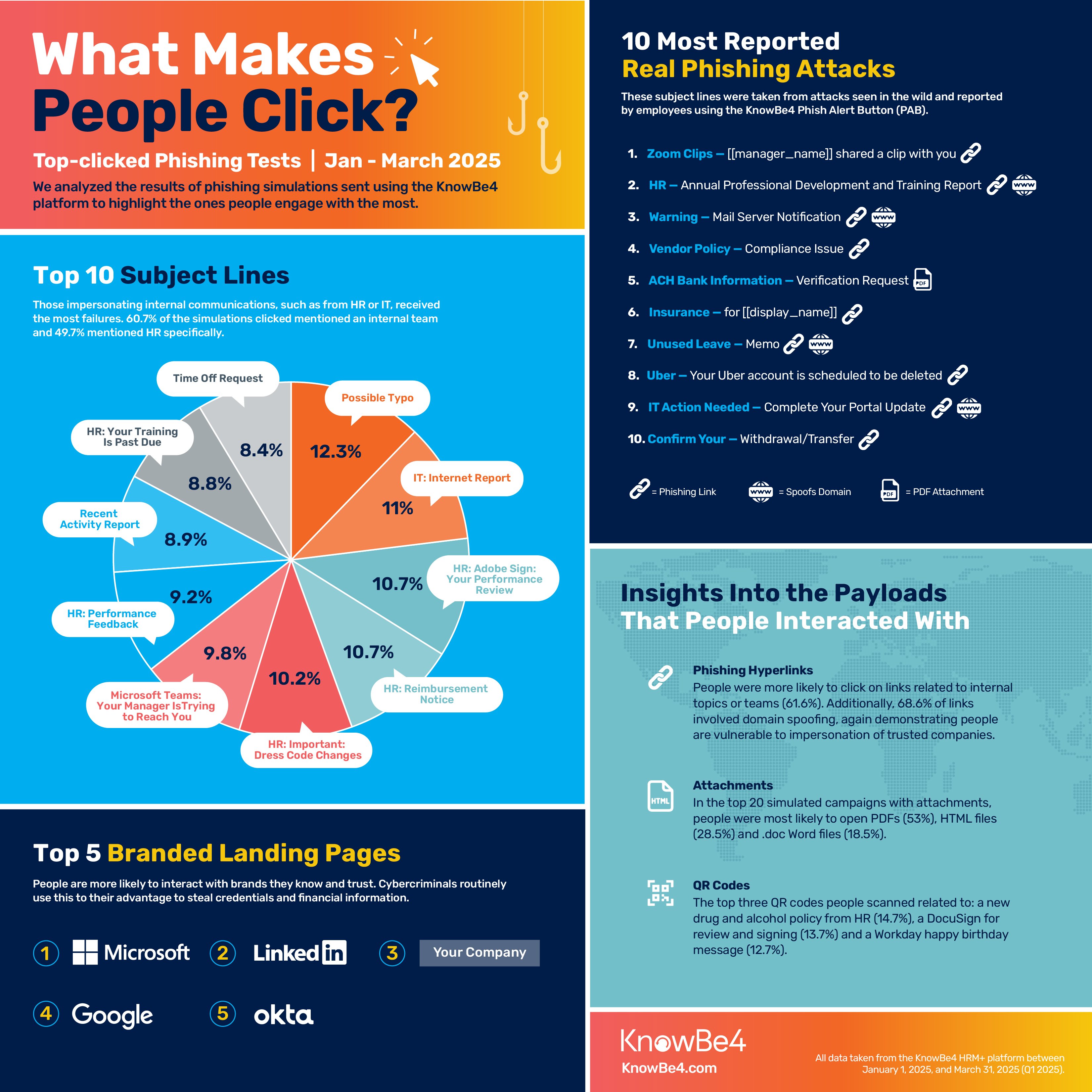
Everyone thinks they can spot a phish. Whether it is an email, SMS text, or QRish phishing, people have an overinflated view of their capabilities to detect them.

A new summary by KnowB4, “What Makes People Click?” provides an insightful review and proves that people still click when curiosity gets the best of them.

According to the summary of top-clicked phishing tests between January and March 2025, phishes impersonating HR or IT are the most successful. People were more likely to interact with links related to internal team topics, open PDFs, HTML files, and .doc Word files and continue to be vulnerable to impersonation of trusted company brands. The companies most likely to be impersonated as part of a successful phishing campaign are Microsoft, LinkedIn, the company the victim works for, Google, and Okta.

And then there are QR codes. Everyone makes fun of me for constantly warning about QR codes, and I am grateful to KnowB4 for having my back on this one. Its summary illustrates that users continue to be duped into scanning malicious QR codes. The top three successful QR scams are QR codes related to the company’s new drug and alcohol policy, a DocuSign for review and signing, and a happy birthday message from Workday. Please take these statistics to heart and beware of these and similar scams. Think twice before clicking on that Happy Birthday message from Workday.

I frequently conduct employee education sessions and carefully follow KnowBe4’s insights. It always has its finger on the pulse and provides practical solutions in real-time. Review its 1st quarter summary, which is jam-packed with useful information for yourself and your users. 

Unfortunately, identity theft continues to increase, and according to Identitytheft.org, the statistics are going to get worse in 2025. Some of the statistics cited by Identitytheft.org include:

  • 1.4 million complaints of identity theft were received by the Federal Trade Commission
  • Total fraud and identity theft cases have nearly tripled over the last decade
  • Cybercrime losses totaled $10.2 billion
  • The median loss to fraud victims is $500
  • There is an identity theft case every 22 seconds
  • 33% of Americans faced some form of identity theft at some point in their lives
  • Consumers aged 30-39 were the most victimized by identity theft
  • Georgia ranked #1 for identity theft and fraud cases

Identitytheft.org concludes:

“Identity theft has been a growing problem in the U.S. for the past few years. It is difficult for victims to deal with these issues because theft methods are becoming even more sophisticated with time. Citizens must safeguard their personal information by utilizing technology such as antivirus protection software, password managers, identity theft protection, and VPNs if they want to avoid identity theft scenarios in 2025.”

These are helpful tips to consider.

British Prime Minister Keir Starmer wants to turn the U.K. into an artificial intelligence (AI) superpower to help grow the British economy by using policies that he describes as “pro-innovation.” One of these policies proposed relaxing copyright protections. Under the proposal, initially unveiled in December 2024, AI companies could freely use copyrighted material to train their models unless the owner of the copyrighted material opted out.

Although some Parliament members called the proposal an effective compromise between copyright holders and AI companies, over a thousand musicians released a “silent album” to protest the proposed changes to U.K. copyright laws. The album, currently streaming on Spotify, includes 12 tracks of only ambient sound. According to the musicians, the silent tracks illustrate empty recording studios and represent the impact they “expect the government’s proposals would have on musicians’ livelihoods.” To further convey their unhappiness with the proposed changes, the title of these twelve songs, when combined, reads, “The British government must not legalize music theft to benefit AI companies.” 

High-profile artists like Elton John, Paul McCartney, Dua Lipa, and Ed Sheeran have also signed a letter urging the British government to avoid implementing these proposed changes. According to the artists, implementing the new rule would effectively give artists’ rights away to big tech companies. 

The British government launched a consultation that sought comments on the potential changes to the copyright laws. The U.K. Intellectual Property Office received over 13,000 responses before the consultation closed at the end of February 2025, which the government will now review as it seeks to implement a final policy.

Soon after the Chinese generative artificial intelligence (AI) company DeepSeek emerged to compete with ChatGPT and Gemini, it was forced offline when “large-scale malicious attacks” targeted its servers. Speculation points to a distributed denial-of-service (DDoS) attack.

Security researchers reported that DeepSeek “left one of its databases exposed on the internet, which could have allowed malicious actors to gain access to sensitive data… [t]he exposure also includes more than a million lines of log streams containing chat history, secret keys, backend details, and other highly sensitive information, such as API Secrets and operational metadata.”

On top of that, security researchers identified two malicious packages using the DeepSeek name posted to the Python Package Index (PyPI) starting on January 29, 2025. The packages are named deepseeek and deepseekai, which are “ostensibly client libraries for access to and interacting with the DeepSeek AI API, but they contained functions designed to collect user and computer data, as well as environment variables, which may contain API keys for cloud storage services, database credentials, etc.” Although PyPI quarantined the packages, developers worldwide downloaded them without knowing they were malicious. Researchers are warning developers to be careful with newly released packages “that pose as wrappers for popular services.”

Additionally, due to DeepSeek’s popularity, it is warning X users  of fake social media accounts impersonating the company.

But wait, there’s more! Cybersecurity firms are looking closely at DeepSeek and are finding security flaws. One firm, Kela, was able to “jailbreak the model across a wide range of scenarios, enabling it to generate malicious outputs, such as ransomware development, fabrication of sensitive content, and detailed instructions for creating toxins and explosive devices.” DeepSeek’s chatbot provided completely made-up information to a query in one instance. The firm stated, “This response underscores that some outputs generated by DeepSeek are not trustworthy, highlighting the model’s lack of reliability and accuracy. Users cannot depend on DeepSeek for accurate or credible information in such cases.”

We remind our readers that TikTok and DeepSeek are based in China, and the same national security concerns apply to both companies. DeepSeek is unavailable in Italy due to information requests from the Italian DPA, Garante. The Irish Data Protection Commissioner is also requesting information from DeepSeek. In addition, there are reports that U.S.-based AI companies are investigating whether DeepSeek used OpenAI’s API to train its models without permission. Beware of DeepSeek’s risks and limitations, and consider refraining from using it at the present time. “As generative AI platforms from foreign adversaries enter the market, users should question the origin of the data used to train these technologies. They should also question the ownership of this data and ensure it was used ethically to generate responses,” said Jennifer Mahoney, Advisory Practice Manager, Data Governance, Privacy and Protection at Optiv. “Since privacy laws vary across countries, it’s important to be mindful of who’s accessing the information you input into these platforms and what’s being done with it.”